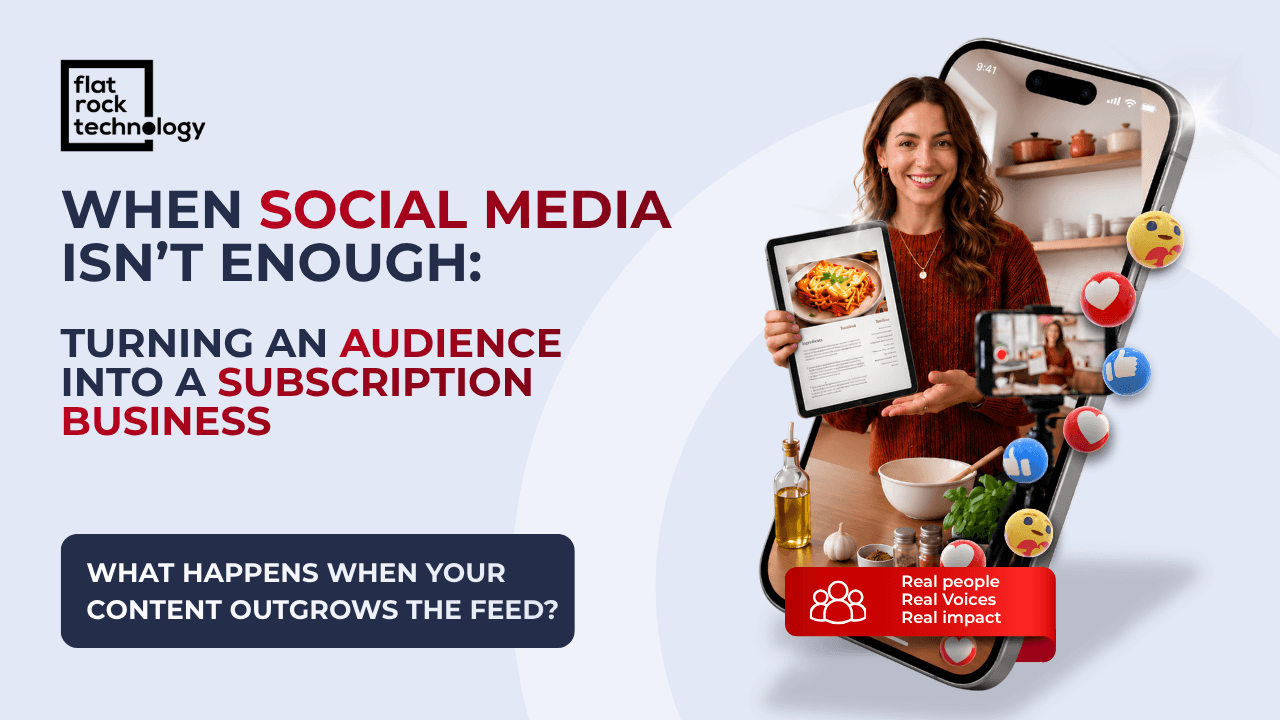
Social media is an incredible place to build an audience.
For creators, educators, coaches and specialist businesses, it provides a way to share knowledge, grow a community and build trust at a scale that would have been difficult to achieve a decade ago.
But eventually, many successful content-led businesses reach the same crossroads.
The audience continues to grow.
The content library becomes larger.
Followers begin asking for more structure, more guidance and easier ways to find the information that matters to them.
At the same time, the business remains dependent on platforms it doesn't control.
Algorithms change. Reach fluctuates. Features evolve. Valuable content quickly disappears into the feed.
That is often the point where social media stops being the product and becomes the marketing channel.
The next stage needs to live somewhere else.
From trusted content to a digital product
One of our recent projects began with exactly this challenge.
The client had built a highly engaged audience around trusted educational content. Alongside a strong social media presence, the business already had a published book, an existing mobile product, paying users and a substantial library of premium resources.
The opportunity wasn't simply to publish more content or attract more followers.
It was to turn an already successful content business into a stronger subscription platform that gave users more value and gave the business greater control over its future.
That meant creating a dedicated mobile experience where subscribers could access hundreds of pieces of premium content in one place, organised around their specific needs.
Instead of scrolling through months of social posts to find a particular piece of guidance, users could discover the right information at the right time.
That is the difference between a content library and a digital product.
A content library stores information.
A digital product helps people use it.
Followers aren't the same as customers
Building a large following is a major achievement.
But followers aren't the same as customers, and influence isn't always the same as a sustainable business model.
Social media creates awareness and engagement, but the platform still controls the relationship.
A subscription product changes that.
Members actively choose to engage with the business. They gain access to structured content and additional value, while the business develops a more direct relationship with its customers.
That can create:
- More predictable recurring revenue
- Greater insight into customer behaviour
- Stronger retention and engagement
- More control over the customer experience
- Less reliance on third-party platforms
The commercial opportunity isn't simply to charge people for content.
It is to create a product that helps customers solve a recurring problem.
People don't subscribe because content exists.
They subscribe because it gives them confidence, convenience, progress or a result they value.
This opportunity goes far beyond influencers
Although this particular project centred around educational content for parents, the same model can apply across many industries.
Subscription and membership products can be built around:
- Health and nutrition
- Fitness and personal training
- Financial education
- Business consulting
- Professional development
- Language learning
- Property and investment education
- Photography and creative skills
- Gardening and lifestyle content
- Pet training
- Specialist membership communities
- Industry knowledge and professional expertise
The subject matter changes.
The underlying opportunity is often the same.
Where people repeatedly return to a trusted individual or business for advice, education or practical support, there may be an opportunity to create more value through a dedicated digital product.
The real challenge isn't simply building an app
This type of work can initially look like a straightforward mobile development brief.
Do we need an iPhone app?
Do we need an Android app?
Do we need both?
How much will it cost?
Those questions matter, but they aren't the best place to start.
The more important questions are:
- What recurring problem brings users back?
- What should sit behind the subscription?
- How should the content be structured?
- What experience will make the product genuinely useful?
- What will the platform need to support in two or three years?
A subscription platform needs more than screens.
It may need user accounts, payment flows, access rules, premium content, saved items, personalisation, search, notifications, analytics and administration tools.
Each of those elements must continue working consistently as the product grows.
That is where product architecture becomes important.
Building for future growth
When businesses think about an app, they often focus on what the user will see.
The technical foundation underneath is just as important.
Decisions made early can determine how easily the business can add features, support new users and expand across platforms later.
In this case, the client already had an existing mobile product and wanted to reach a wider audience without creating unnecessary duplication.
Rather than building and maintaining two entirely separate versions of the same product logic, we adopted an architecture using Kotlin Multiplatform and Compose Multiplatform.
This allows core parts of the product to be shared across Android and iOS, including areas such as:
- User accounts
- Subscription rules
- Content access
- Data handling
- Product logic
- API communication
Platform-specific functionality can still be developed separately where it creates a better experience.
The aim isn't to replace native development entirely.
It is to be deliberate about what should be shared and what should remain platform-specific.
For this product, that creates a stronger foundation for future development and makes it easier to keep the experience aligned as the platform evolves.
Five lessons for businesses considering a subscription platform
1. Solve a recurring problem
People rarely subscribe simply because a business has produced a lot of content.
They subscribe because the product helps them achieve something repeatedly.
The problem being solved should shape the content, features and customer experience.
2. Make content easier to use
Large libraries of articles, videos or resources can quickly become overwhelming.
Successful products do more than store content.
They help users discover what is relevant to them.
3. Design around the customer journey
The structure of the platform should reflect how customers actually use the service.
What do they need first?
What brings them back?
What should they see next?
The product journey matters as much as the volume of content.
4. Build beyond the first release
Launching the initial version is only the beginning.
The product will need to respond to customer feedback, new commercial opportunities and future feature requirements.
The technical foundation should make that evolution easier rather than creating additional complexity.
5. Let the business model lead the technology
Technology shouldn't be selected because it is fashionable.
It should support the customer experience, commercial model and long-term roadmap.
For some products, fully native development will still be the right choice.
For others, a shared architecture may provide the right balance of quality, speed and long-term maintainability.
The right answer depends on the product and the business behind it.
Building the next stage of the business
The most valuable outcome wasn't simply producing another mobile application.
It is helping an established content business evolve into a platform that can support recurring revenue, stronger customer relationships and future growth.
That changes the conversation.
It becomes about customer experience, product strategy, content structure, commercial control and scalability, not only software development.
For many creators and content-led businesses, the next major opportunity isn't finding more followers.
It is creating more value for the audience they have already built.
Is your audience ready for its own platform?
If you have built an engaged audience through social media, a website, a newsletter or an existing membership community, there may come a point where your current channels no longer fully support the relationship you have created.
The next stage could be a subscription app, a learning platform, a customer portal, a member hub or a wider digital product.
The right solution depends on the audience, the business model and the long-term roadmap.
At Flat Rock Technology, we help businesses design, build and scale digital products that are created for long-term growth.
Because sometimes the biggest opportunity isn't building another app.
It is building the next stage of your business.