

In a perfect world scenario, project managers have unlimited time, all the resources they need, and the scope of the project never changes. However, in the real world, nothing could be further from the truth. Every project, small or big, has constraints, and it's the project managers job to deliver quality projects within these limitations.
-
Most common constraints PMs have when starting the new project include time, cost, and scope. Together they make what we call project management triangle.
-
This article will help you understand the project management triangle better, overview its challenges, and let you know how can you use it for delivering quality projects.
What is the project management triangle?
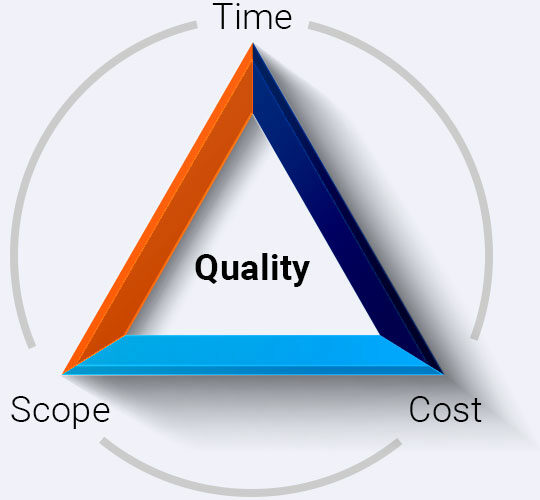
The three constraints of the iron triangle
The three angles of the project management are interdependent. One cannot change the scope of the project, delivery time, or the cost of it, without it affecting the other two.
To understand the project management triangle better and see how are they connected, let's break down each of the angles.
A closer look at three angles of the project management triangle
1. Time
-
-
Underestimation of time
-
Hence, it is wise to consider each team members' abilities and workload to create a schedule that reflects reality. At the same time, take a look at the similar projects your company has completed before and use past experiences.
-
-
Internal delays
-
Staffing issues
-
-
2. Cost
-
While often they cannot control changes in cost, the best way to deal with it is to plan and try to prevent any possible exceeds in the budget.
-
Cost underestimation
Cost underestimation happens when the initial estimates are too optimistic, don't include possible inefficiencies and when there are mistakes in the budget.
-
Project delays
-
Staffing issues
-
The best way to deal with the changes in the cost is to prevent it from happening by thorough planning and estimating. Project managers can minimize overruns by adding the contingency budget into the plan. They should check if the budget follows the initial estimates and make necessary changes if something does not go according to it.
-
3. Scope
Changes in scope can sometimes set the whole project upside down as it greatly affects the time and budget.
Additional feature requests
Request for an additional issue can come both externally and internally.
If the additional feature does not require a lot of work, does not change the dependencies and you cannot accommodate it within the set timeline and budget, it is not a big problem. By implementing it, you can make the final product more valuable. If not, you need to be firm and make how adding it will affect the time and cost.
-
Changing specifications
-
Best way to avoid it is to document all requirements and specifications and communicate it openly with the client and the team. All parties that are involved in the project should sign the documentation that defines the deliverables, specifications and other details regarding the project.
-
If the client still requests changes, you can enact a change control process for those changes that affect the budget and time.
-
Obscure requirements
The bottom line
Project management triangle is a give-and-take balance that is the core of delivering a quality project that is beneficial and valuable for the client and the development company.
-